
“I bring creative mischief” 💭
Mia Lobel on building kind culture at Slate

When Mia Lobel started as Slate’s executive producer of podcasts last summer, she didn’t come in and overhaul the team or cut a bunch of shows. She did something simpler but potentially much more powerful: she asked questions.
Mia asked her team: what’s your biggest success? What’s your biggest pain point?
What’s your goal for the next year?
She even wanted to know: what’s one thing you do to take care of yourself?
Mia is a veteran audio producer who has spent her career championing creativity, diversity, and character-driven storytelling. She was formerly VP of content and production at Pushkin, and has also taught audio storytelling at Newmark Graduate School of Journalism and Wesleyan University.
In this issue, Mia told me how she builds a workplace culture of kindness, what video podcasting means for narrative audio, why she left Pushkin … and why we all need a ‘creative flock’ right now.
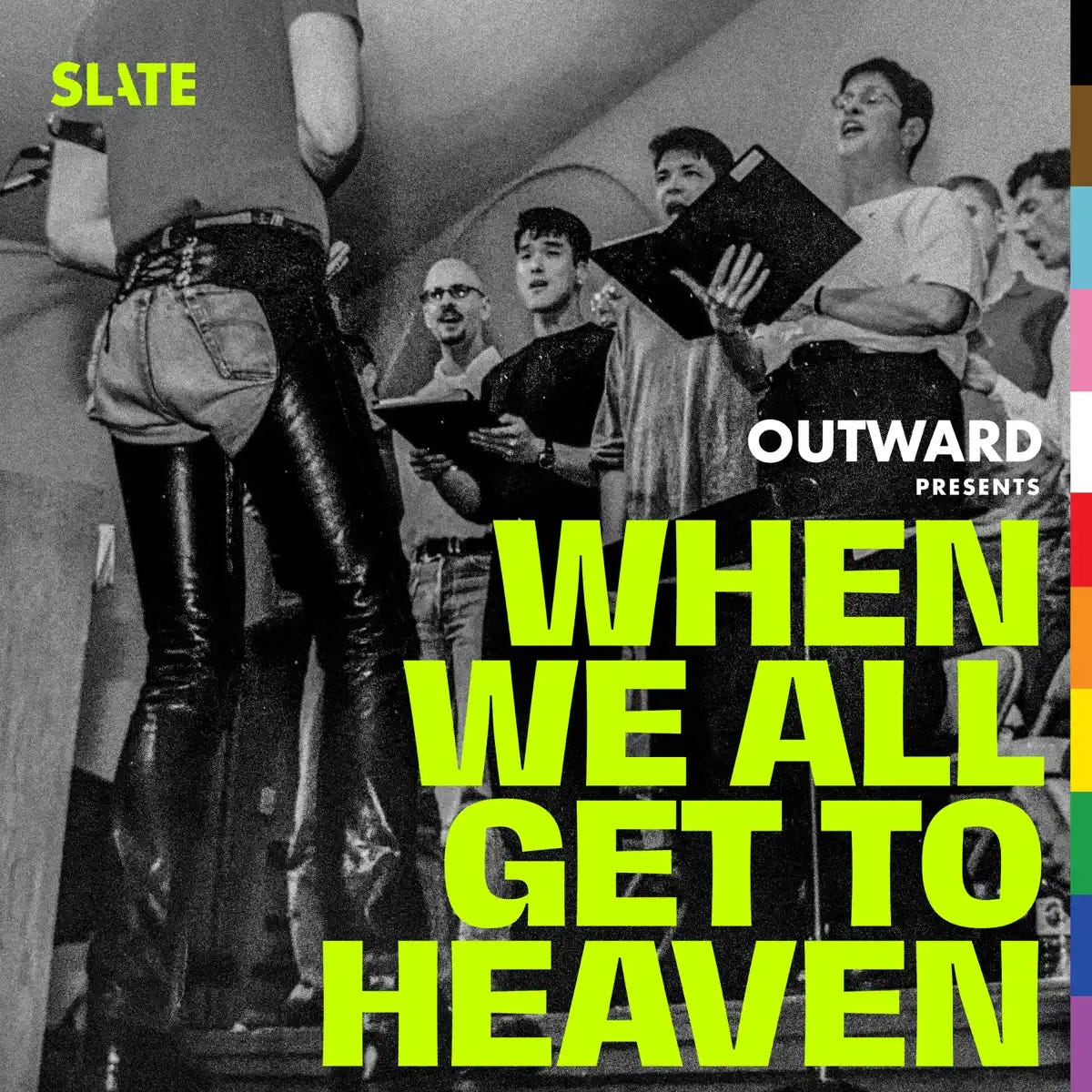
Mia and I chatted back in October, right after Slate had just released a beautiful new show called When We All Get To Heaven, a series that tells the story of one of the first gay-positive churches, and how it faced the personal, social, and political trials of the AIDS epidemic, including the deaths of hundreds of its members.
I started by asking Mia about the origins of the show…
I started at Slate in June 2025. One of the first emails I got was from Anna Sale, host of Death Sex and Money, forwarding me an email from Krissy Clark [When We All Get To Heaven’s managing producer], saying, “Hey, I’m working on this thing. We’re looking for distribution. Might you have any interest?”
And I just love narrative. That’s where I came up, that’s what I’ve always loved. Slate doesn’t do a whole lot of narrative; they have Slow Burn, which is their crown jewel, and they have Decoder Ring, which is this amazing long-running narrative show.
But other than that, they’re all primarily chat shows. And so I listened to the first episode, and I heard how gorgeous it was. It was 10 years in the making. It had been grant funded, and they were just looking for distribution. They specifically wanted to work with Slate, which was really exciting to me.
I brought it to my boss, Hillary Frey, and she was like, “what if we just put it in the Outward feed?” [Outward is Slate’s queer podcast]. We had a number of conversations about how to make it work. Ultimately, we were able to create a deal where very little money changed hands.We could give them a network and a platform, and they could give us content that we would never be able to make on our own. I mean, the fact that so much went into it – 10 years of production! That’s not something – even with Slow Burn – we would ever be able to do. It feels like a really wonderful partnership from my perspective.
I want this to work for them so badly. I’ve made so many narrative productions, and I know what heart rending work [it is] and just how much goes into something like that. Holding the stories of these people. A lot of the people whose voices you hear are no longer around. They’ve died of AIDS. There’s just so much riding on this for the participants of the series, and I want to do them justice, I want them to get heard, and I want those stories to be out there in the world.
I hope that we can give them what they’re looking for, and I hope everyone finds it, and everyone listens to it. But this kind of partnership is definitely something that Slate hasn’t really done before.
What other shows are you focusing on at Slate?
Well since I started [the role], I’ve been on a ‘get to know you’ tour. I was at Slate about 10 years ago, and very few people who were there then are still here. So I’ve really spent most of my time getting to know everyone, getting to know the shows, getting to look beneath the hood and try to see how everything works.
Every shop is a little bit different. And I’ve been at a few of them! I told everyone [at Slate], ‘I’m not going to come in and remake the whole thing. I want to work with what you’ve got.’ I want to keep what makes Slate so special, and try to breathe fresh life into projects that need it.
Three of our shows are on YouTube. [Video] is just where things are going, especially for chat shows. So it was about figuring out which shows would be good to start with. Obviously you’re not going to do that with Slow Burn or Decoder Ring -- because the editorial process is so in-depth. It needs to be an interview show that you could pretty easily port from audio into video – and then get the team on board.
There’s a lot of anxiety around video. There’s a lot of resistance. I feel it too: narrative does not work on YouTube. But it’s just the reality of the business. The first Slate YouTube video was from our parenting show Care and Feeding. The other two, Slate Money and Political Gabfest, are also live.
I’m curious how you met that resistance to video amongst your team?
How do I get people’s buy in? I mean, everyone knows that this is the direction that podcasts are going in, right? It’s understood: YouTube is where it’s at, like it or not, that’s what all the metrics show. We have to be there.
So my argument is we have to think business minded. We can still continue to do the audio work we love; this does not have to completely upend our production processes.
The idea for me is that it’s relatively low stakes. Like, just try it and let’s see what happens. Have fun with it. Get good lighting. We got webcams for the hosts, got them some nice ring lights, made sure that they understood that they were going to be on camera.
I really tried to foster an air of experimentation and fun. That’s what I bring generally, is a little bit of creative mischief. That’s how podcasting started. It was just all creative mischief. It was like, hey, what if we get rid of the broadcast clock, and we could make whatever we wanted for as long as we wanted in this brand new space called podcasting?
So what if you just approach [YouTube] with that mentality of let’s have some fun with this and see what happens, and not put so much pressure on it?
The other thing was ensuring that I wasn’t asking people to do so much more work than they were already doing. Slate hired a video editor who is essentially taking the recording and doing a video cut of the same thing. So the audio process continues on as planned. And it shouldn’t really affect the audio side at all.
What do you think the migration to YouTube means for narrative audio?
That’s a great question. I think there is still a really big audience for narrative audio. I think that it holds its own separate space. People still have to multitask. They still go to the gym and go for runs and take long drives and wash dishes: all of those things that everybody fell in love with podcasting for in the first place. I think there is still a real appetite for audio only.
I think the question is, how do you pay for it? That’s the real struggle, because it just takes a long time to do well and to do beautifully. I’m not worried that there’s not going to be a desire for it. I think that anyone who makes it has to get a little bit more creative about how they’re paying for it, and whether that comes through grants or through academic institutions or through just labor of love… people do need to get paid. I was one of the authors of the AIR rate guide, and I believe very strongly in fair pay for your work, but you have to consider the cost when it comes to making these things, and then just figure it out.
Let me take you a step back, because I wanted to ask what appealed to you about the role at Slate. Why did you decide to take this job?
My last full time job was at Pushkin. Before that I was a freelancer for 10 years. My last freelance gig was on contract with Panoply in 2016, making Revisionist History. For season two, they said you need to come work for us full time, or we’ll find somebody else to do your job. Well, it wasn’t quite that stark, but it was sort of like: we want you here full time. So I took the job at Panoply.
I was there for three years, and then Panoply ended all content. That’s where Megaphone became their product. (Laura Mayer did an amazing piece about what happened there in Shameless Acquisition Target, which I highly recommend. It’s amazing.)
So basically, me and my whole team got laid off. At the same time, Malcolm Gladwell and Jacob Weisberg were spinning up this new thing, which became Pushkin Industries. Almost within 24 hours, Malcolm was like, ‘I know you’re losing your job, but come do this other thing with me’.
I spent four years building up Pushkin, making lots and lots and lots of shows there. At the end of 2022 I decided to leave on my own. I was burnt out, I’d had enough. I freelanced for the next two years, which was good, but my finances took a major hit.
It’s freelancing, right? It’s kind of hit or miss. I made an amazing show during that time with Jane Perlez, called Face Off, which is still going on [season three came out in November]. I had to leave it when I started my job at Slate, which was very sad.
I had some teaching gigs, and I did a lot of my own writing on Substack with some pieces about the industry. But ultimately, I was a little bit lonely. I’m very much a team player. I like having regular colleagues. I had a lot of accountability buddies, and people I was working with informally. I was excited to be on a formal team again.
And then there’s the fact that I have two teenagers; one of them is a senior in high school, he’s going to college next year. My husband’s a school teacher. We don’t have a lot of resources, so that was definitely a factor as well.
Before I even applied, I had a conversation with editor in chief Hillary Frey. I was put in touch by a friend of mine Sara Burningham, who makes Amicus [at Slate]. I was a little nervous about going back full time, because my work at Pushkin had been so exhausting in the end. [And Sara was like] just have a conversation with Hillary and just see how it goes.
We had a great conversation; we really hit it off. I just liked her thinking. I’ve always liked Slate; I’m a huge fan of Slow Burn. Plus their writing is just so funny and smart. After my call with Hillary, I thought it would be a good fit. I did many rounds of interviews and was very happy in the end when they made the offer.
You wrote a brilliant piece on why you left Pushkin. Slate sounds like a very different environment – but are you approaching it differently? And how?
Yeah, well I learned so much in my [first stint] at Slate [in 2016]. I really became a manager there. At Panoply, I was a managing producer, and I had people reporting to me.
At Pushkin I hands-on produced the first seven seasons of Revisionist History. I was still in the mixes – like I was the producer. Over the course of my time there, I really moved away from production and into management, and I liked that. But I think the problem was the decision-making at the management level. I had ideas, and I felt like I wasn’t really being listened to. I did both [producer and manager] roles for a while at Pushkin, and I had to figure out the separation between making content and managing content, which are very different jobs.
I’ve come into [my current job at] Slate knowing that my role is as a manager. I am not in the business of telling shows how to make their content. I’ll listen to stuff once it’s done, and give feedback. But I am not in the weeds on production at all. I really trust the team.
I am all in on strategic thinking, and creating a workplace culture that feels really creative and experimental and kind and fun and transparent. I’m [using] all the things I’ve learned about management, and have the support of an editor in chief who I really like and respect.
How are you fostering that culture? How does that happen day-to-day?
Keep reading with a 7-day free trial
Subscribe to The Audio Storyteller to keep reading this post and get 7 days of free access to the full post archives.